The short answer
Most businesses that want an app do not need one. An app earns its cost only when it does something a website genuinely cannot — work offline, run in the background, use the phone hardware deeply, or send notifications to people who already use you regularly. If your goal is being found by new customers, a website beats an app at that, because nobody downloads an app for a business they have not heard of.
On this page
We build mobile apps. So it is worth being upfront: most of the time, when somebody asks us for one, our honest recommendation is not to build it.
Not because apps are bad, and not because the work is uninteresting. It is because an app carries a cost profile most people are never shown before they commit, and because the thing they actually wanted — more customers — is something an app is unusually bad at delivering.
Here is how to tell which side of that line you are on.
Start with the download problem
This is the part that decides it for most businesses, and it has nothing to do with technology.
To use your website, someone taps a search result. To use your app, they have to find it in a store, decide it is worth space on their phone, wait for it to install, and usually create an account. That is a lot of steps, and each one loses people.
Crucially, they have to be willing to do all that before they have got any value from you. A stranger who has never heard of your business will not do it. They will use whichever competitor let them book, price or buy in the browser they already had open.
The four reasons an app is genuinely the right call
These are the cases where a website cannot do the job, no matter how well it is built. If none of them describes you, you are probably looking at a website.
1. It has to work without a connection
A field crew in a rural area, an inspector in a basement, a technician in an underground parkade. If the work happens where the signal does not reach, and data has to be captured then synced later, that is an app.
Websites can do a limited version of this, but "limited" is the operative word. If offline is a core requirement rather than a nice-to-have, build the app.
2. It has to do something while nobody is looking at it
Tracking a route in the background, monitoring a Bluetooth sensor, logging activity through the day. A website only runs while its tab is open and in front of the user. An app can keep working when the phone is in a pocket.
3. It needs deep access to the hardware
Ordinary camera access, basic location and file uploads all work fine on a website — that surprises people. What does not is the deeper end: continuous background location, Bluetooth accessories, NFC in most cases, advanced media processing, or tight integration with the phone platform itself.
4. Notifications are central to how it works
If the product does not function without reliably reaching the user — a dispatch tool, a two-way messaging service, a critical alerting system — an app gives you a far more dependable channel than the web does, particularly on iPhones.
Be honest about the word "central", though. Wanting to send occasional promotions is not this. Email and text already do that, and they reach people who have not installed anything.
The costs nobody mentions in the sales conversation
The build price is the part everyone discusses. It is rarely the part that causes regret.
| Cost | What it actually means | Applies to a website? |
|---|---|---|
| Two of everything | What it actually meansiOS and Android are separate platforms. Cross-platform tools narrow the gap but do not close it — testing, release and platform-specific bugs still double up. | Applies to a website?No. One website serves every device. |
| Store developer accounts | What it actually meansApple and Google both charge to publish. At the time of writing Apple runs an annual developer fee and Google charges a one-off registration — check their current pricing, as both set it independently. | Applies to a website?No. |
| Review before every release | What it actually meansEach update is submitted and reviewed before it reaches users. A fix is not live when you finish it — it is live when it is approved. | Applies to a website?No. A website fix is live when you deploy it. |
| Forced maintenance | What it actually meansiOS and Android release major versions yearly. Apps that are not updated eventually break, get warnings, or are removed from the store. This happens whether or not you wanted new features. | Applies to a website?Rarely, and far less aggressively. |
| Getting people to update | What it actually meansSome users will run an old version for years, so you end up supporting several at once. | Applies to a website?No. Everyone has the current version. |
That fourth row is the one that catches people. An app is not a thing you buy once. It is a thing you keep, like a vehicle — and if you stop maintaining it, it does not sit there working. It degrades and eventually disappears from the store.
The middle option most people have not been told about
There is a third answer between "website" and "app", and it fits a surprising number of the businesses that come to us asking for an app.
A modern website can be built as a progressive web app, so that it installs to the home screen. It gets its own icon, opens without browser chrome around it, works offline to a degree, and on Android can send notifications. To the customer it looks and feels much like an app. There is no store, no review queue, no download, and it is one thing to maintain rather than three.
The trade-offs against a native app are real and you should know them: notification support on iPhones is weaker and has more conditions attached, deep hardware access is limited, and you do not get a listing in the app stores — which matters if store presence is itself part of what you are buying.
But if what you wanted was "our regulars can tap an icon and book in two seconds", this often delivers it for a fraction of the cost and none of the ongoing store obligation.
What we usually recommend instead, and why
When a small business tells us they want an app, the underlying goal is almost always one of three things. None of them needs an app.
- "We want more customers." An app cannot do this — people do not download apps for businesses they have not heard of. Being findable on Google and having a site that answers the price question does it.
- "We want to look professional." A well-built website does this more reliably than an app nobody has installed. An app with three downloads and a 2023 copyright notice does the opposite.
- "We want customers to book and pay easily." A good booking flow on a website does this now, for everyone, with no install step in the way.
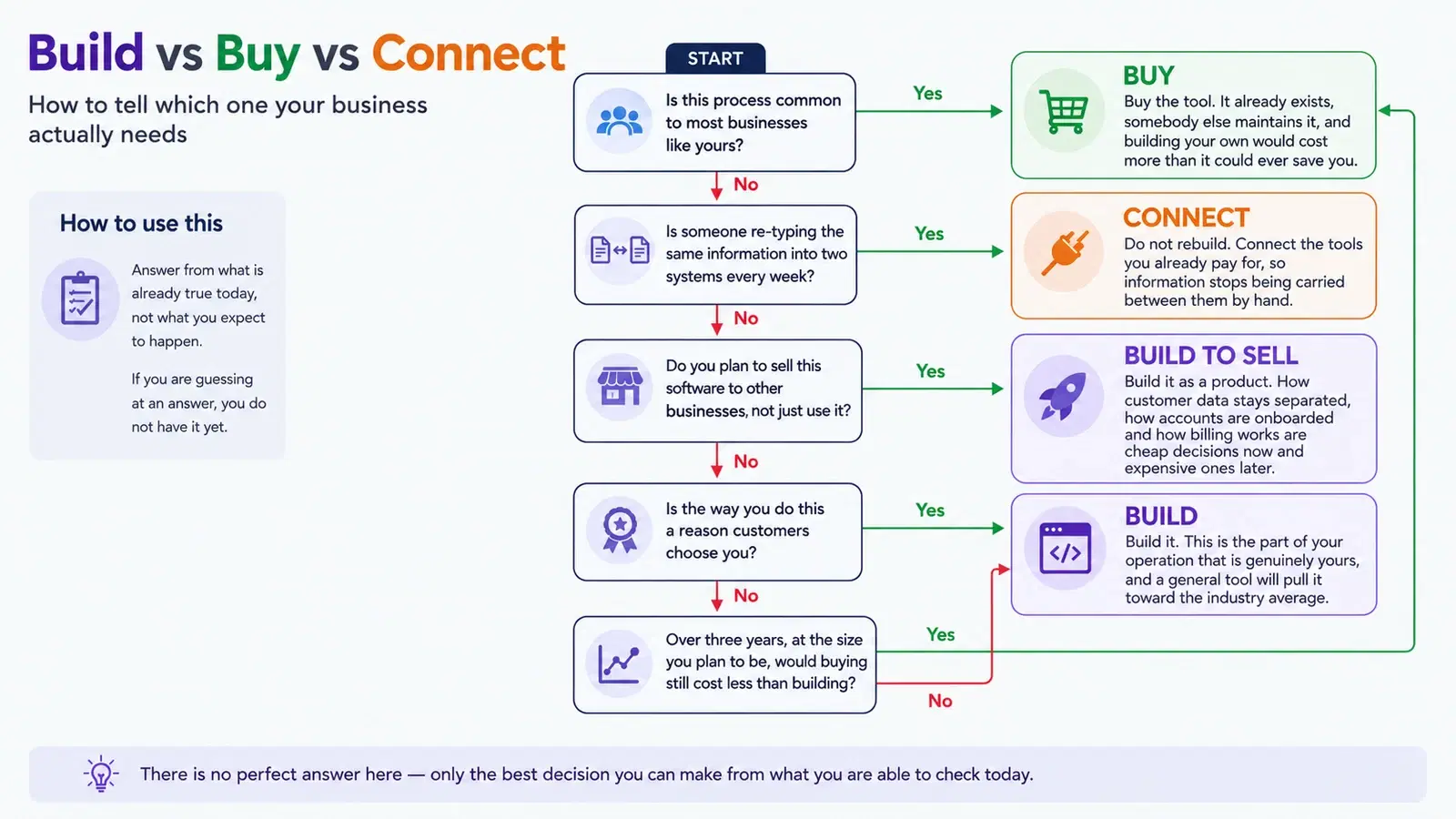
One exception is worth naming. If what you are building is a product you intend to sell, rather than a tool for running a business you already have, the question changes shape. There the first step is usually a deliberately small version that tests whether anyone wants it — and the argument about which platform it lives on can wait until you know the answer to that.
A decision you can make in five minutes
Work down this list. Stop at the first "yes".
- 1Does it have to work with no connection? → Build the app.
- 2Does it have to run in the background, or use Bluetooth or continuous location? → Build the app.
- 3Is reliable notification delivery the core of the product, not a marketing extra? → Probably the app.
- 4Do the same people use you weekly or more, and would genuinely value a two-second route in? → Consider the installable website first, then the app if that falls short.
- 5None of the above? → Build the website properly. Spend the difference on being findable.
One last thing worth saying, because it comes up constantly: choosing the website now does not close the door. A well-built site and a solid backend are the same foundation an app would need later. If the business grows into needing one, you will not be starting again — and you will know far more about what the app should actually do, because real customers will have told you.
Deciding later, with evidence, is almost always cheaper than deciding now, on a hunch.
Common questions
Do I need a mobile app for my small business?
Usually not. An app is worth its cost when it must work offline, run in the background, use the phone hardware deeply, or deliver notifications as a core function. If your goal is reaching new customers, a website works better, because people do not install apps for businesses they have not heard of yet.
Is a mobile app better than a website for getting new customers?
No, and this is the most common misunderstanding. A website is found through search by people who have never heard of you. An app requires someone to already want you enough to install it. Apps are a retention tool for existing customers, not an acquisition tool for new ones.
What does it cost to maintain a mobile app?
More than most people expect, and the cost continues whether or not you add features. iOS and Android both release major versions each year, and apps that are not kept current eventually break or get removed from the stores. Ask any prospective developer what three years of maintenance costs with no new features — that figure matters more than the build price.
Can a website do the things an app does?
More than most people realise. Camera access, basic location, file uploads and payments all work on a modern website, and a site can be built to install to the home screen and work partly offline. What websites still cannot match is true offline operation, background processing, deep hardware access such as Bluetooth, and notification reliability on iPhones.
What is a progressive web app?
A website built so it can be added to the phone home screen with its own icon, opening without browser chrome and working offline to a degree. It sits between a website and an app: no store listing, no download, no review queue, and one codebase to maintain — with weaker notification support on iPhones and limited hardware access as the trade-off.
Should I build for iOS or Android first?
Whichever your actual customers use, which is worth checking rather than assuming — it varies a lot by industry and region. If the answer is genuinely both and budget is tight, that is usually an argument for a cross-platform build or for reconsidering whether a website would serve you better.
If I build a website now, will I have to start over to build an app later?
No, if it is built sensibly. The backend, the data and the business logic a website needs are largely the same foundation an app would use. Building the website first also means that when you do decide, you will be deciding from evidence about what customers actually do rather than from a guess.
If you want help with this
- Mobile app development — For the cases above where an app genuinely is the right answer — iOS, Android or cross-platform.
- Web development — Including installable sites that give regulars an icon without the app-store overhead.
- Startup MVP development — If it is a product rather than a business tool, start by testing the idea cheaply.